 Fix My Chess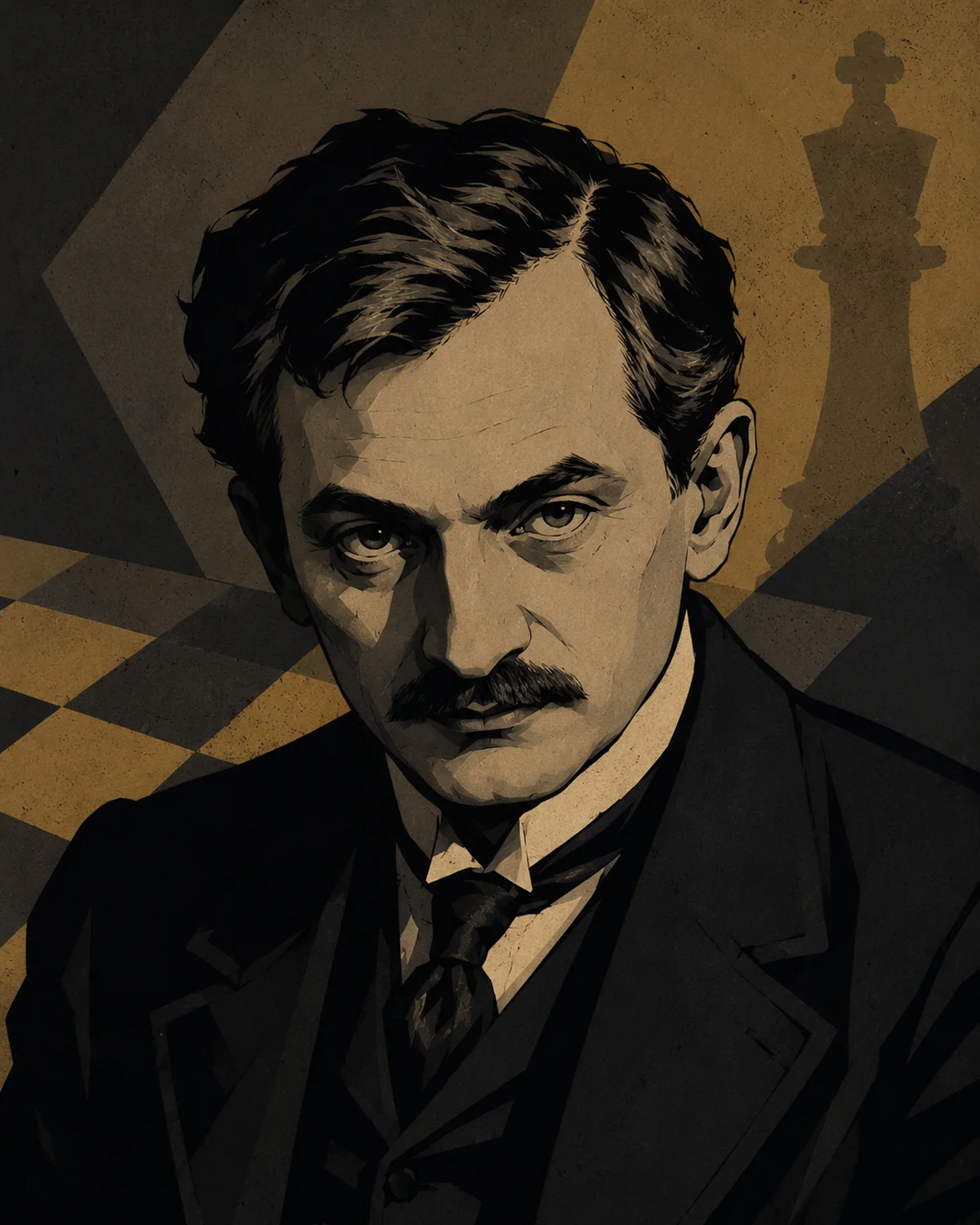
A Fix My Chess master
Lasker
The Fighting Champion
“Play the move your opponent least wants to face. Chess is a fight before it is art.”
What it cures in your game
If your dominant leak is time trouble, Lasker is your antidote. The way he plays — the same you see in these games — is exactly what you need to internalize. In Fix My Chess you choose him as your master and train under his style, game by game, until that leak closes.
His life in chapters
- 1868–1893
The mathematician learns to fight
I was born in Berlinchen, Prussia, in 1868, and my first love was mathematics — chess my brother Berthold taught me came second, and paid the bills first. I learned the game in Berlin cafés, where a bad move costs money and an illusion costs more. By my twenties I was beating masters across Europe. I understood early that chess is not played against pieces. It is played against a man.
- 1894–1913
Taking the crown — and keeping it
In 1894, at twenty-five, I beat the great Steinitz for the world championship, and in the rematch I removed all doubt. Then I defended: Marshall, Tarrasch, Schlechter, Janowski — each wanted a different fight, so I gave each a different Lasker. In between I earned my doctorate in mathematics; a theorem of mine still carries my name. The critics said my moves were not always the best. I answered that they were the best against that opponent, on that day.
- 1914–1921
St. Petersburg, the war, Havana
St. Petersburg 1914: past forty-five, I finished ahead of them all, the young Capablanca included — my proudest fight. Then the war devoured Europe, my savings, and seven years of my prime. When we finally met in Havana in 1921, the heat and the years were his allies, and I resigned the match to the better man. Twenty-seven years I had held the crown. No one has held it longer.
- 1922–1932
The old lion at New York
They thought the ex-champion would fade into his books of philosophy and mathematics. Instead, at New York 1924, at fifty-five, I won the tournament ahead of Capablanca and Alekhine both. A title can be taken from you; the fight cannot. I wrote my Manual of Chess in those years — not a book of variations, but of struggle.
- 1933–1941
Exile
In 1933 the Nazis took my country from me, and my wife Martha and I began the wandering years — England, Moscow, finally New York. At Moscow 1935, at sixty-six, I went through the whole tournament unbeaten, third among the young lions. I died in New York in 1941, far from home but never from the board. Chess, I always said, is above all a fight — and I fought to the last.
Games to relive
- Lasker — Bauer
Is this your master?
Diagnose your latest games and find out which master cures your dominant leak. Free, in a minute, no account.